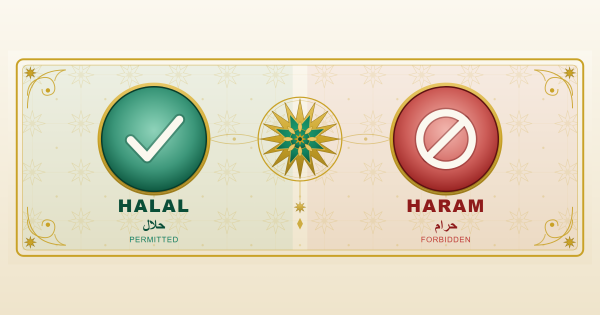
Haram (Arabisch: حَرَام) betekent "verboden" of "prohibited." In de islam is iets dat als haram wordt omschreven een handeling die Allah duidelijk onwettig heeft gemaakt: het vermijden ervan is een daad van gehoorzaamheid die wordt beloond, en het opzettelijk doen ervan is een zonde. Het tegenovergestelde is halal (حَلَال), wat "wettig" of "toegestaan" betekent. Begrijpen wat haram betekent - en hoe het zich verhoudt tot halal en de categorieën daartussenin - is een van de eerste stappen om het geloof met vertrouwen te beoefenen.
Deze gids legt de betekenis van haram uit, hoe geleerden bepalen dat iets verboden is, veelvoorkomende voorbeelden, en hoe haram verschilt van het louter afkeurenswaardig.
Wat betekent "haram" in de islam?
Linguïstisch, haram is afgeleid van een wortel die iets heiligs of apartgezet betekent, en in de islamitische wetgeving verwijst het naar wat beslist verboden is. Iemand die zich onthoudt van een haram-handeling uit gehoorzaamheid aan Allah verdient beloning, terwijl het begaan ervan een zonde is waarvoor men rekenschap verschuldigd is. Omdat het oordeel ernstig is, zijn geleerden voorzichtig om nooit iets haram te noemen zonder duidelijk bewijs.
Halal en haram: de twee ankerpunten
Moslims spreken vaak over halal en haram als een paar, maar ze bevinden zich aan de twee uiteinden van een bredere schaal. Een nuttig principe in alledaagse, wereldse zaken (in tegenstelling tot handelingen van aanbidding) is dat de standaard is toelaatbaarheid: dingen worden als toegestaan beschouwd, tenzij er duidelijk bewijs is dat het tegendeel aantoont. Handelingen van eredienst werken andersom - deze worden vastgesteld door openbaring in plaats van verzonnen. Daarom vereist het verklaren dat iets haram is bewijs, niet alleen persoonlijke voorkeur of gewoonte.
De vijf categorieën van islamitische oordelen
Islamitische geleerden classificeren menselijke handelingen in vijf welbekende categorieën (al-ahkam al-khamsa). Haram is slechts één daarvan:
- Fard / Wajib (verplicht) - verplicht; bijv. de vijf dagelijkse gebeden. Het verrichten ervan wordt beloond, het verzuimen ervan is zondig.
- Mandub / Mustahabb (aanbevolen) - aanbevolen; het wordt beloond wanneer gedaan, maar het nalaten ervan is geen zonde.
- Mubah (toegestaan) - neutraal en toegestaan; het brede domein van gewone halal-keuzes.
- Makruh (ongewenst) - afgeraden; het wordt beloond om het te vermijden, maar het is niet zondig om het te doen.
- Haram (verboden) - verboden; zondig om te doen, en beloond om het te vermijden.
Het plaatsen van haram in dit grotere plaatje helpt twee veelvoorkomende fouten te voorkomen: elk ongewenst ding als verboden beschouwen, en ernstige verboden behandelen alsof het kleinigheden zijn.
Hoe wordt bepaald dat iets haram is?
Een uitspraak dat iets haram is, is geen kwestie van mening. Gekwalificeerde geleerden leiden dit af uit de vastgestelde bronnen van de islamitische wet:
- De Koran - expliciete verboden in de openbaring van Allah.
- De authentieke Soennah - de leerstellingen en het voorbeeld van de Profeet Mohammed (vrede zij met hem).
- Consensus van geleerden (ijma') en degelijke analogische redenering (qiyas) toegepast door opgeleide geleerden.
De Profeet Mohammed (vrede zij met hem) zei: "Het toelaatbare is duidelijk en het verboden is duidelijk, en tussen beide zijn twijfelachtige zaken die veel mensen niet kennen." Hij raadde voorzichtigheid aan bij wat twijfelachtig is. Daarom is, wanneer een zaak werkelijk onduidelijk is, de veilige weg iemand met kennis te vragen in plaats van te gokken.
Veelvoorkomende voorbeelden van haram
De volgende categorieën zijn breed aanvaard. Specifieke gevallen kunnen nuance en verschillen tussen de rechtsscholen bevatten, dus beschouw dit als een overzicht in plaats van een persoonlijke fatwa.
Voedsel en drank
Varkensvlees en afgeleiden daarvan, bloed, aas (een dier dat stierf zonder correcte slacht), vlees dat niet volgens islamitische richtlijnen geslacht is, en alle bedwelmende middelen - alcohol (khamr) en andere stoffen die de geest vertroebelen.
Vermogen en transacties
Rente/usura (riba), gokken (maysir), omkoping, diefstal, fraude en het onrechtmatig toe-eigenen van andermans eigendom.
Spraak en gedrag
Liegen, achterklap (ghibah), laster, schending van vertrouwen, en het onrechtvaardig behandelen of schaden van anderen (zulm). Boven alles staat shirk - het associëren van partners met Allah - wat het zwaarste verbod van allemaal is.
Haram vs. makruh: verboden vs. ongewenst
Een veelvoorkomend punt van verwarring is het verschil tussen haram en makruh. Iets makruh is afkeurenswaardig: je wordt beloond voor het vermijden ervan, maar het is geen zonde als je het doet. Iets haram is verboden: het opzettelijk doen ervan is een zonde. Het uit elkaar houden van beide beschermt een gelovige zowel tegen onnodige schuldgevoelens over afkeurenswaardige maar toegestane zaken als tegen onachtzaamheid ten opzichte van echte verboden.
Kinderen leren over halal en haram
Voor gezinnen is het doel niet simpelweg een lijst met regels, maar een liefdevolle relatie met Allah waarin goede keuzes natuurlijk aanvoelen. Uitleg die past bij de leeftijd, consistentie tussen ouders en het verbinden van halal en haram met vriendelijkheid, eerlijkheid en dankbaarheid helpen kinderen deze waarden te verinnerlijken. Onze bibliotheek heeft praktische gidsen precies daarover:
Blijf leren
Gerelateerde gidsen uit de Kuttab-bibliotheek
Veelgestelde vragen
Wat betekent haram in de islam?
Haram betekent "verboden" of "prohibited". Het verwijst naar een handeling die Allah duidelijk onwettig heeft gemaakt. Het vermijden van een haram-handeling uit gehoorzaamheid wordt beloond, en het opzettelijk begaan ervan is een zonde.
Wat is het verschil tussen halal en haram?
Halal betekent wettig of toegestaan, en haram betekent verboden. Het zijn de twee uitersten van een vijfdelige schaal die ook verplichte, aanbevolen en afgeraden handelingen omvat. In alledaagse wereldse zaken is de uitgangsregel dat dingen zijn toegestaan tenzij er duidelijk bewijs is dat ze verboden zijn.
Is makruh hetzelfde als haram?
Nee. Makruh betekent 'afkeurenswaardig' of 'afgeraden': je wordt beloond voor het vermijden ervan, maar het is geen zonde om het te doen. Haram is verboden, en het opzettelijk doen ervan is zondig. Alleen wat door duidelijk bewijs is vastgesteld wordt haram genoemd.
Hoe bepalen geleerden dat iets haram is?
Een oordeel dat iets haram is wordt ontleend aan de Koran, de authentieke soenna van de Profeet Mohammed (vrede zij met hem), de consensus van geleerden en degelijke analogische redenering door bevoegde geleerden - niet aan persoonlijke mening of gewoonte. Wanneer een kwestie echt twijfelachtig is, is het advies iemand met kennis te raadplegen.
Wat zijn enkele veelvoorkomende voorbeelden van haram?
Algemeen erkende voorbeelden zijn varkensvlees, bloed, aas en bedwelmende middelen zoals alcohol; rente (riba), gokken, diefstal en fraude met betrekking tot rijkdom; en liegen, achterklap en onrechtvaardigheid in gedrag. Het ernstigste verbod is shirk - het toekennen van deelgenoten aan Allah. Specifieke gevallen kunnen geleerde nuances bevatten, raadpleeg dus een gekwalificeerde geleerde voor persoonlijke oordelen.
Wil je de Koran, Arabisch en islamitische waarden studeren met een gekwalificeerde docent? Ontdek de docenten van Kuttab en begin in je eigen tempo te leren.
Gerelateerd: haram
Haram (Arabic: حَرَام) means "forbidden" or "prohibited." In Islam, something described as haram is an act that Allah has clearly made unlawful: avoiding it is an act of obedience that is rewarded, and doing it knowingly is a sin. Its opposite is halal (حَلَال), meaning "lawful" or "permitted." Understanding what haram means - and how it fits alongside halal and the categories in between - is one of the first steps in practising the faith with confidence.
This guide explains the meaning of haram, how scholars determine that something is forbidden, common examples, and how haram differs from the merely disliked. It is written as a plain-language overview for learners and parents; for a ruling on a specific personal situation, always consult a qualified scholar.
What does "haram" mean in Islam?
Linguistically, haram comes from a root meaning something sacred or set apart, and in Islamic law it refers to what is decisively prohibited. A person who abstains from a haram act out of obedience to Allah earns reward, while committing it is a sin for which one is accountable. Because the ruling is serious, scholars are careful never to label something haram without clear evidence.
Halal and haram: the two anchors
Muslims often speak of halal and haram as a pair, but they sit at the two ends of a wider scale. A helpful principle in everyday, worldly matters (as opposed to acts of worship) is that the default is permissibility: things are considered allowed unless there is clear evidence making them otherwise. Acts of worship work the other way - they are established by revelation rather than invented. This is why declaring something haram requires proof, not merely personal preference or custom.
The five categories of Islamic rulings
Islamic scholars classify human actions into five well-known categories (al-ahkam al-khamsa). Haram is only one of them:
- Fard / Wajib (obligatory) - required; e.g. the five daily prayers. Doing it is rewarded, neglecting it is sinful.
- Mandub / Mustahabb (recommended) - encouraged; rewarded when done, but no sin for leaving it.
- Mubah (permissible) - neutral and allowed; the broad space of ordinary halal choices.
- Makruh (disliked) - discouraged; rewarded to avoid, but not sinful to do.
- Haram (forbidden) - prohibited; sinful to do, rewarded to avoid.
Seeing haram inside this bigger picture helps prevent two common mistakes: treating every disliked thing as forbidden, and treating serious prohibitions as if they were minor.
How is something determined to be haram?
A ruling of haram is not a matter of opinion. Qualified scholars derive it from the established sources of Islamic law:
- The Qur'an - explicit prohibitions in Allah's revelation.
- The authentic Sunnah - the teachings and example of the Prophet Muhammad (peace be upon him).
- Scholarly consensus (ijma') and sound analogical reasoning (qiyas) applied by trained scholars.
The Prophet Muhammad (peace be upon him) said: "The lawful is clear and the unlawful is clear, and between the two are doubtful matters which many people do not know." He advised caution with what is doubtful. This is why, when a matter is genuinely unclear, the safe path is to ask someone with knowledge rather than to guess.
Common examples of haram
The following are widely agreed-upon categories. Specific cases can carry scholarly nuance and differences between the schools of law, so treat this as an overview rather than a personal fatwa.
Food and drink
Pork and its by-products, blood, carrion (an animal that died without proper slaughter), meat not slaughtered according to Islamic guidance, and all intoxicants - alcohol (khamr) and other substances that cloud the mind.
Wealth and dealings
Interest/usury (riba), gambling (maysir), bribery, theft, fraud, and taking others' property unjustly.
Speech and conduct
Lying, backbiting (ghibah), slander, breaking trusts, and wronging or harming others (zulm). Above all stands shirk - associating partners with Allah - which is the gravest prohibition of all.
Haram vs. makruh: forbidden vs. disliked
A frequent point of confusion is the difference between haram and makruh. Something makruh is disliked: you are rewarded for avoiding it, but you are not sinful if you do it. Something haram is forbidden: doing it knowingly is a sin. Keeping the two apart protects a believer from both unnecessary guilt over disliked-but-allowed things and carelessness toward genuine prohibitions.
Teaching children about halal and haram
For families, the goal is not simply a list of rules but a loving relationship with Allah in which good choices feel natural. Age-appropriate explanations, consistency between parents, and connecting halal and haram to kindness, honesty and gratitude all help children internalise these values. Our library has practical guides on exactly this:
Keep learning
Related guides from the Kuttab library
Frequently asked questions
What does haram mean in Islam?
Haram means "forbidden" or "prohibited." It refers to an action that Allah has clearly made unlawful. Avoiding a haram act out of obedience is rewarded, and doing it knowingly is a sin.
What is the difference between halal and haram?
Halal means lawful or permitted, and haram means forbidden. They are the two ends of a five-part scale that also includes obligatory, recommended, and disliked actions. In everyday worldly matters the default is that things are permitted unless there is clear evidence that they are forbidden.
Is makruh the same as haram?
No. Makruh means disliked or discouraged: you are rewarded for avoiding it, but it is not sinful to do. Haram is forbidden, and doing it knowingly is sinful. Only what is clearly established by evidence is called haram.
How do scholars decide that something is haram?
A ruling of haram is derived from the Qur'an, the authentic Sunnah of the Prophet Muhammad (peace be upon him), scholarly consensus, and sound analogical reasoning by qualified scholars - not from personal opinion or custom. When a matter is genuinely doubtful, the guidance is to ask someone with knowledge.
What are some common examples of haram?
Widely agreed-upon examples include pork, blood, carrion and intoxicants such as alcohol; interest (riba), gambling, theft and fraud in wealth; and lying, backbiting and injustice in conduct. The gravest prohibition is shirk - associating partners with Allah. Specific cases can carry scholarly nuance, so consult a qualified scholar for personal rulings.
Want to study the Qur'an, Arabic and Islamic values with a qualified teacher? Explore Kuttab's teachers and start learning at your own pace.
Related: haram